

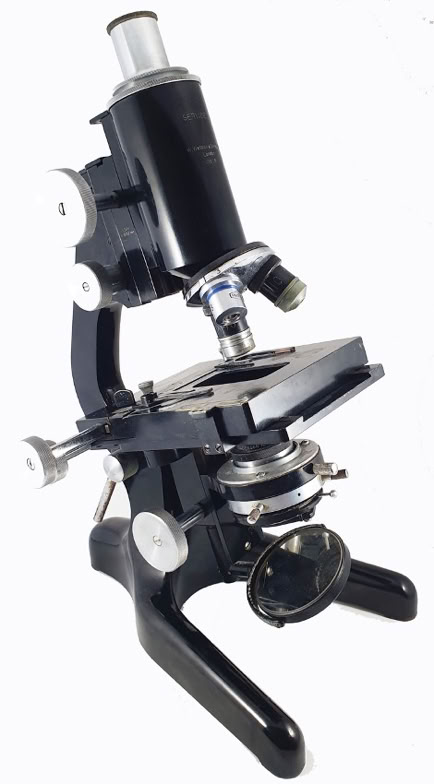


Microscope 10
(W Watson & Sons Ltd; Service I model; c. 1952)
W. Watson & Sons was a prominent British manufacturer of optical, scientific, photographic, and medical instruments, with operations in both London and Edinburgh. The company was founded in 1837 by William Watson at 71 City Road, London, where it remained until relocating to 313 High Holborn in 1861. The business traded as W. Watson & Son from 1867 and adopted the name W. Watson & Sons in 1882. Its expansion continued with the acquisition of John Browning & Co. in 1900, and in 1908 the company was incorporated as W. Watson & Sons Ltd. By the early twentieth century, Watson had established an international reputation for the manufacture of microscopes, optical instruments, cameras, and photographic equipment. An advertisement published in the British Industries Fair Catalogue in 1929 described the company as an exhibitor of optical, scientific, and photographic instruments, highlighting its range of microscopes designed for medical, industrial, and educational applications. During the 1950s, the firm relocated to 25 West End Lane, Barnet, Hertfordshire, where it remained until the late 1960s. In 1957, the company was acquired by Pye of Cambridge, and in 1967 became part of the Philips group. By around 1970, microscope production had ceased.
Microscope 10 is a Watson ‘Service I’ model, first advertised in 1941 in the Journal of Scientific Instruments (Figure 1). The instrument was described as being “designed to meet the demand for a robust monocular microscope incorporating those features required by the research worker”. Bearing the serial number 111575, the microscope can be dated to the early 1950s. The stage carries the serial number 29102, and the instrument is fitted with a Watson Universal No. 1 condenser (K2891). An engraved inscription, “Vet. Med. Camb. 56”, suggests that the microscope was formerly owned by the Department of Veterinary Medicine, University of Cambridge, with the number likely referring to an inventory or accession identifier used by the department.

Figure 1. Watson’s Service I microscope as illustrated in a 1941 advertisement published in the Journal of Scientific Instruments