|
|
Microscope Museum Collection of antique microscopes and other
scientific instruments |
|
|
|
|
|
Microscope
155 (Flatters
& Garnett; dissecting microscope; first half of 20th century)
Abraham Flatters and Charles Garnett
established their company in 1901 to supply microscopical equipment. The
first location of the company was as a chemist shop at 46 Deansgate,
Manchester, displaying the microscope and lantern slides made by Flatters. By
1906, the company sold the chemists on Deansgate and moved to 32 Dover
Street, near the University and opposite the Manchester High School for
Girls. In 1909, a serious rift developed between Flatters and the other
directors. The Garnetts agreed to buy out his share and Flatters set up a
business with some other members of the staff under the name of Flatters,
Milbourne and McKechnie. In 1913, Flatters and Garnett Ltd moved to larger
premises at 309 Oxford Road, opposite the University. Flatters & Garnett
Ltd expanded its business steadily during the 1920s, increasing their range.
In 1932, the firm acquired a large Victorian house on Wynnstay Grove in
Fallowfield where it moved the microslide, specimen, photographic and
chemical departments. In 1950, the company introduced the Mikrops industrial
projector. This replaced the microscope for routine examination in many
laboratories. Due to financial problems, the company went into liquidation in
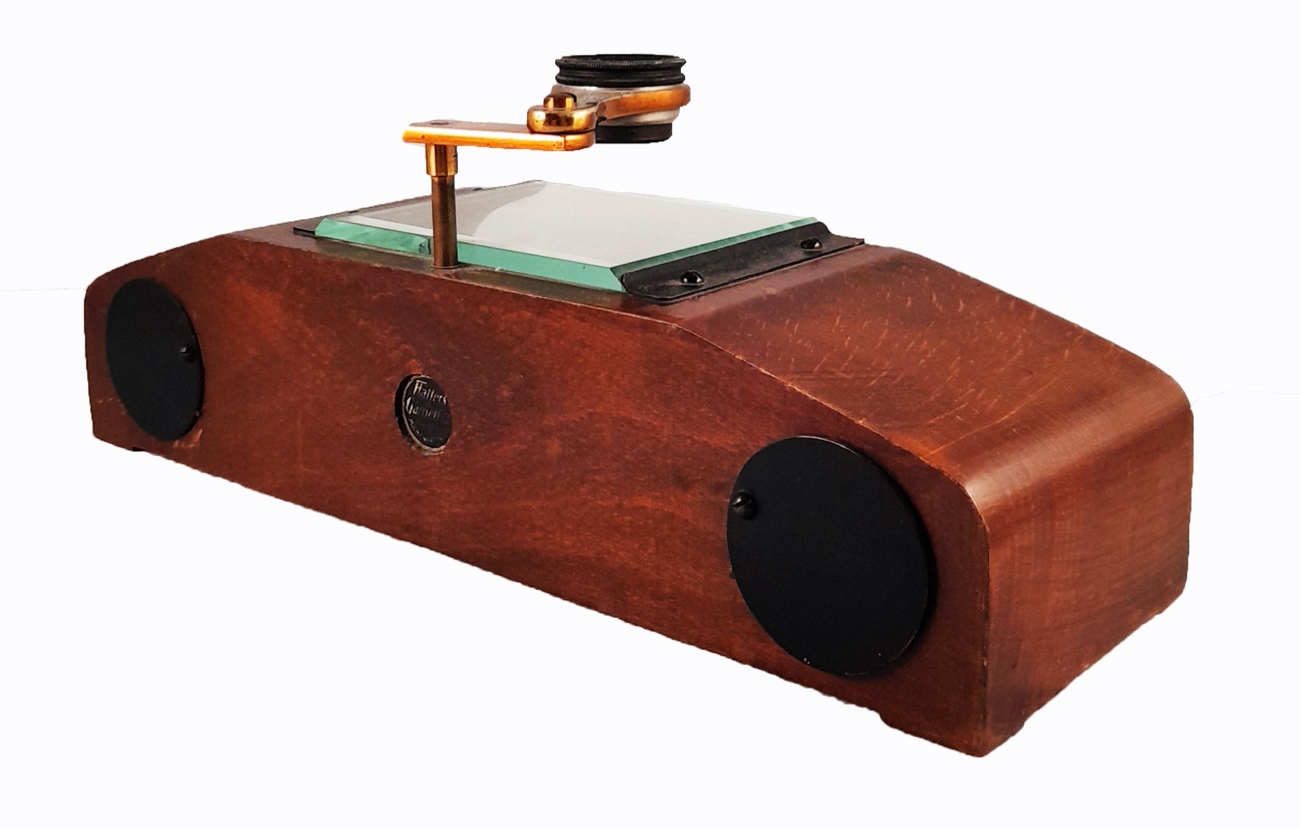
1967. Microscope 155 is a dissecting microscope sold by Flatters &
Garnett and can be dated to the first half of the 20th century
(Figure 1). This instrument should be a version of the Cornex dissecting
microscope made by R&J Beck, for which Flatters & Garnett were distributers.
The dissecting microscope is made of solid mahogany with tapered ends that
form rests for the hands. There is a white glass plate located underneath the
glass stage, placed at a 45-degree angle for illumination. The lens is held
in a fitting which swings over the stage plate and slides up and down for
focussing. This type of microscope was used mainly to study small flowers and
plants as well as small animals.
Figure 1. Dissecting
microscope as featured in a 1929 Flatters & Garnett’s catalogue. |