
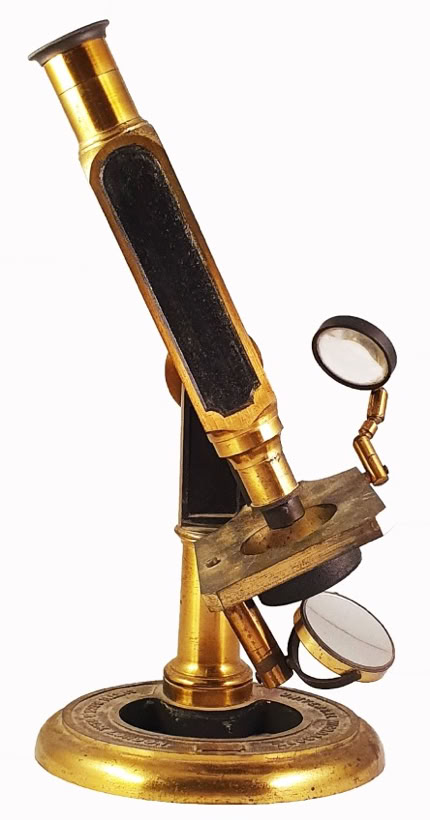


Microscope 94
(Smith, Beck & Beck; Universal Microscope, c. 1860)
Smith, Beck & Beck was established in London through a partnership between James Smith (1800–1873) and Richard Beck (1827–1866), later joined by Richard's brother, Joseph Beck. The Beck brothers were nephews of Joseph Jackson Lister, the distinguished British optician and physicist who pioneered the development of achromatic lenses and made important advances in microscope optics. In developing his improved microscope, Lister collaborated with James Smith, then an employee of the instrument-making firm of William Tulley, who was responsible for constructing the microscope stand. Smith subsequently established his own optical instrument workshop in 1837. Through Lister's influence, his nephew Richard Beck began an apprenticeship with Smith in 1843. In 1847, Smith and Richard Beck entered into partnership, establishing the firm Smith & Beck. The name changed to Smith, Beck & Beck in 1854, following Joseph Beck's entry into the business in 1851. When James Smith retired in 1865, the company became R. & J. Beck, a name it retained for many decades.
Microscope 94 is engraved “Smith, Beck & Beck, London” and was marketed as the firm's Universal Microscope (Figure 1). Bearing serial number 3071, it can be dated to approximately 1860. Its construction features a substantial cylindrical pillar supporting the body tube and stage, together with a single mirror and a biconvex lens for reflected-light illumination. Focusing is achieved by means of a chain rack mechanism, which raises and lowers the body tube relative to the stage.

Figure 1. The Smith Beck & Beck Universal microscope as engraved in Richard Beck’s book ‘The Achromatic Microscope’ from 1865.