
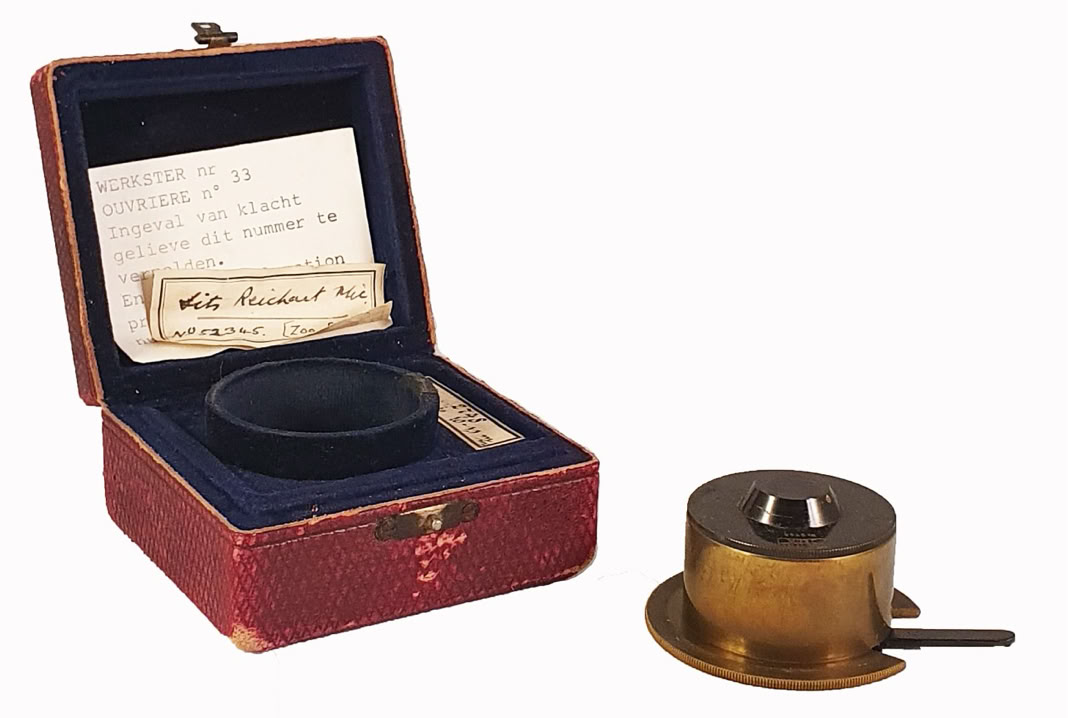
Object 10
Paraboloid condenser by Carl Zeiss (c. 1900)
A paraboloid condenser manufactured by Carl Zeiss, Jena, dating from c. 1900. This optical accessory was designed for dark-field illumination, in which light is directed onto the specimen at a steep angle, allowing light scattered by the specimen to enter the objective while the surrounding field remains dark.
In 1846, Carl Zeiss established a workshop for precision mechanics and optical instruments in Jena, Germany. He gradually concentrated his activities on microscope manufacture, and the quality of his instruments soon attracted customers beyond the regional market, with microscopes being exported internationally. In 1866, Zeiss recruited the physicist Ernst Abbe to improve the optical performance of his microscopes. Abbe became a partner in the business in 1877 and made fundamental contributions to the scientific understanding and development of microscope optics. Following Carl Zeiss's death in 1889, Ernst Abbe established the Carl Zeiss Foundation, which eventually became the sole owner of the company. From the 1890s onwards, Abbe's scientific discoveries and systematic approach to optical design and manufacturing were applied to other areas of optics, leading to the development of new products, the expansion of the company's activities and considerable commercial growth. In 1893, Carl Zeiss opened its first foreign subsidiary in London. Before the outbreak of the First World War, the company had established a network of international branches and facilities. However, the war forced the closure of its overseas operations and severely disrupted its international business. The company subsequently experienced further difficulties and major organisational changes between the two world wars and the end of the Second World War in 1945. After 1945, the international operations gradually recovered and expanded. Today, Carl Zeiss AG operates as a holding company with several specialised subsidiaries. In addition to its historical centres in Jena and Oberkochen, Germany, the company has major production and development facilities in other locations, including Wetzlar and Göttingen in Germany, Dublin and Minneapolis in the United States, and Shanghai in China.