
Object 139
Abbe drawing apparatus by Ernst Leitz (1920s)
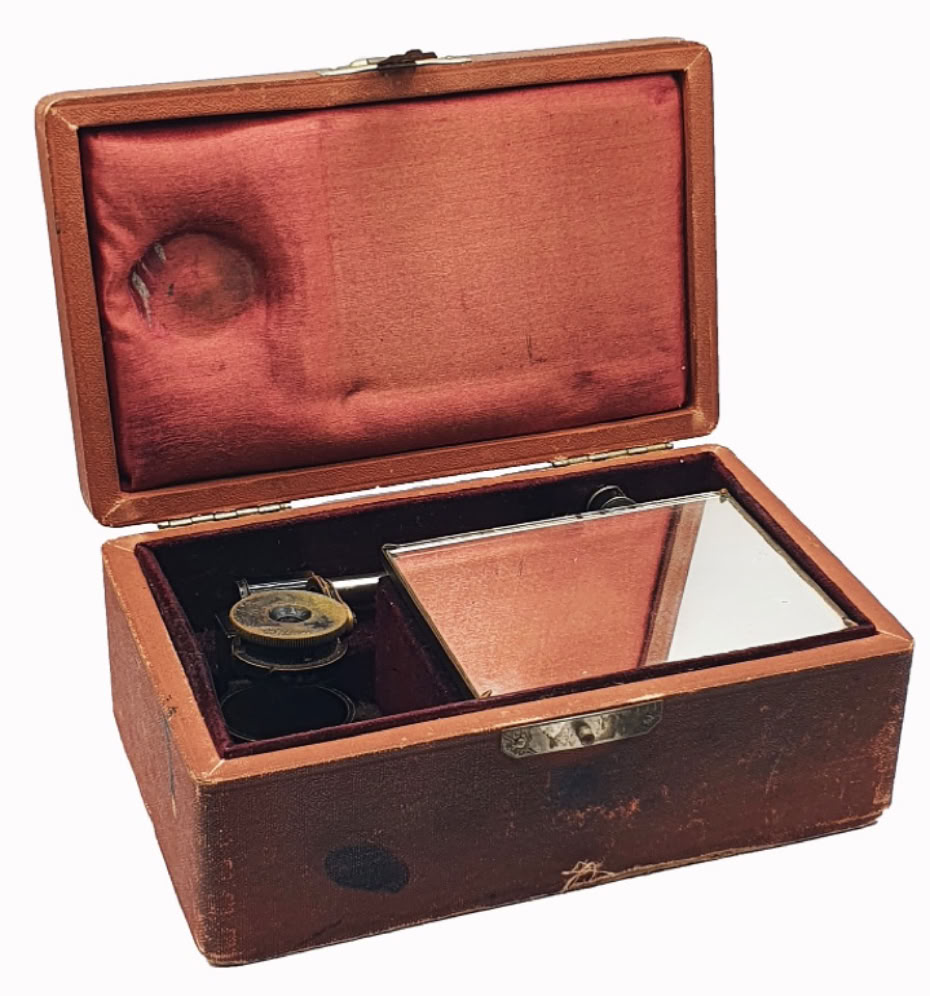
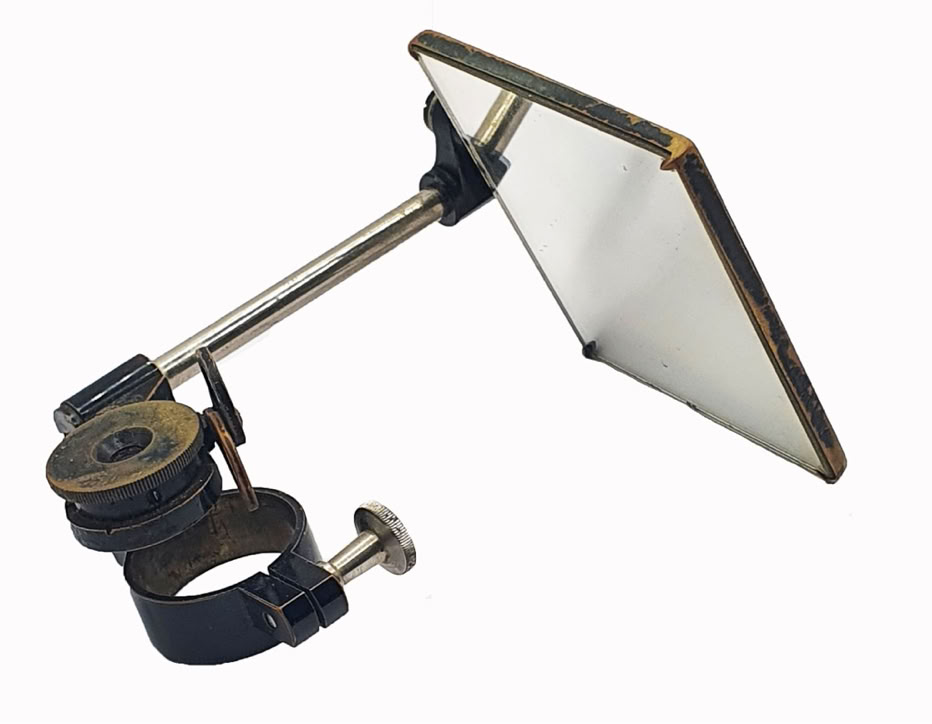
Abbe drawing apparatus manufactured by Ernst Leitz, probably dating from the 1920s (Figure 1).
This type of camera lucida was invented by Ernst Abbe in the 1880s and is designed to be clamped around the eyepiece of a microscope. It enables accurate drawings to be made of specimens viewed through the microscope by optically superimposing the microscopic image onto the drawing surface. The apparatus consists of a prism mounted above the microscope eyepiece and a relatively large mirror positioned a few inches away. The prism has a silvered surface with a small, clear aperture at its centre. Light reflected from the drawing paper by the mirror enters the prism and is redirected by its silvered surface into the observer's eye. At the same time, the specimen is viewed directly through the clear aperture. The two images are therefore superimposed, allowing the observer to see the microscopic image overlaid on the drawing paper and trace its outlines accurately. The microscope is preferably used in the vertical position; if it is inclined, the drawing paper must be positioned in the same plane as the microscope stage.
In 1849, Karl Kellner established the Optical Institute in Wetzlar, Germany, which soon specialised in microscope manufacture. In 1865, the company employed Ernst Leitz as an engineer, and he subsequently became a partner. Leitz took over the business in 1869 and renamed it the Optical Institute of Ernst Leitz. Following his death in 1920, his son, Ernst Leitz II, became the sole owner of the company. During the 1970s, competition from Japanese manufacturers, particularly Olympus and Nikon, increased significantly, with these companies offering modern, high-quality microscopes at competitive prices. Several established microscope manufacturers in Europe and the United States consequently closed, merged or were acquired. In 1974, Wild Heerbrugg acquired a majority interest in Ernst Leitz Wetzlar, although the Leitz company continued to develop new ranges of compound microscopes. The last member of the Leitz family retired from the company's board of directors in 1986. In early 1987, Ernst Leitz Wetzlar GmbH and Wild Heerbrugg AG merged to form the Wild Leitz Group. In 1988, the group was reorganised into smaller companies, with Leica Camera becoming a separate business. In 1990, the merger of Wild Leitz Holding AG and the Cambridge Instrument Company resulted in the formation of Leica Holding B.V. The Leica name subsequently became the principal brand for the group's microscopes and other scientific optical instruments.

Figure 1. Abbe drawing apparatus as pictured in Ernst Leitz’s catalogues from 1909 (top) and 1926 (bottom).