


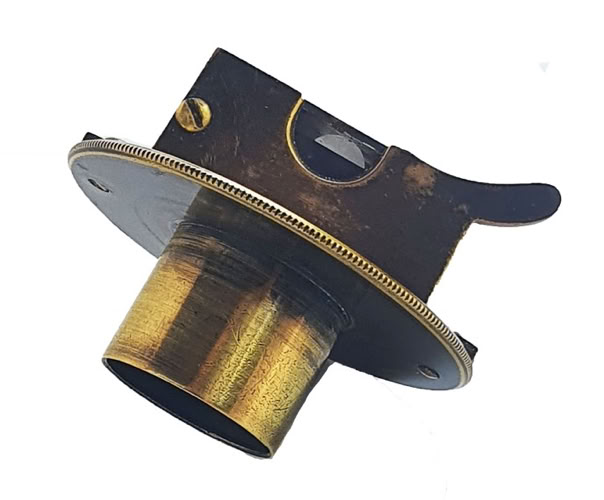

Object 151
Camera lucida Wollaston-type
This Wollaston-type camera lucida is a scientific drawing instrument dating from the second half of the nineteenth century. A camera lucida is an optical device designed to assist accurate drawing by allowing the user to view both the specimen and the drawing surface simultaneously, with the two images optically superimposed.
The principle of the camera lucida was first described by Johannes Kepler in 1611, although practical instruments were not developed until the early nineteenth century. Several designs subsequently appeared, with the Wollaston type becoming one of the most widely used. Invented and patented by William Hyde Wollaston in 1807, this design employs a specially shaped prism positioned above the observer's eye. By looking through the edge of the prism, the user can see the reflected image of the specimen superimposed on the drawing surface, allowing it to be traced with considerable accuracy. The camera lucida quickly became an important tool for scientists, naturalists and artists. It was also adapted for use with microscopes, enabling the accurate drawing of microscopic specimens. Early microscope-mounted versions often consisted of a prism attached to a replacement eyepiece fitting. They remained valuable aids to scientific illustration before photomicrography became widely available.