

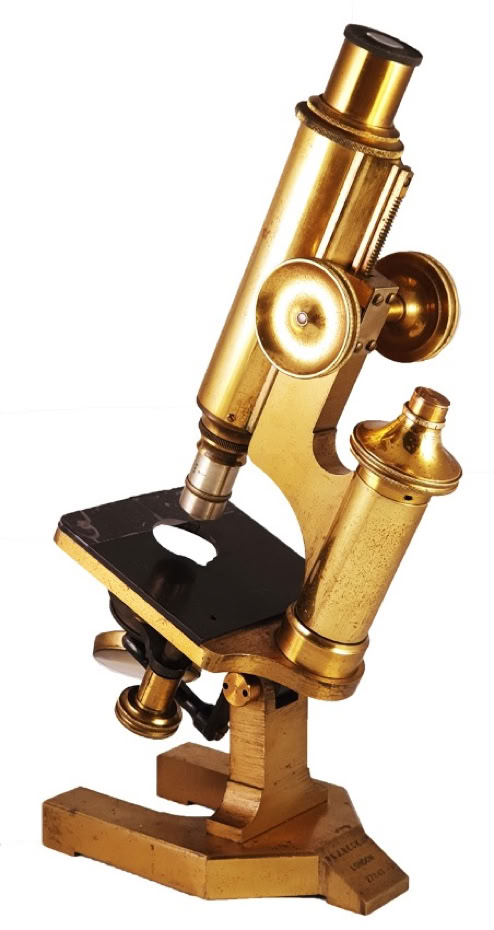


Microscope 38C
(R & J Beck; improved continental microscope, with substage; c. 1900)
R & J Beck holds an important place in the history of British microscope manufacturing. The company's origins date to 1847, when Richard Beck (1827–1866) entered into partnership with James Smith (1800–1873) in London. Richard and his brother Joseph Beck were nephews of Joseph Jackson Lister, a distinguished British optician and physicist whose work on achromatic lenses helped advance the design of the optical microscope. When Lister commissioned the manufacture of his improved microscope, he worked with James Smith, then an employee of the instrument-making firm of William Tulley, to produce the stand. Smith subsequently established his own optical instrument workshop in 1837. Through Lister's influence, Richard Beck became Smith's apprentice in 1843. In 1847, Smith and Richard Beck formed a partnership under the name Smith & Beck. The company was renamed Smith, Beck and Beck in 1854, following Joseph Beck's entry into the business in 1851. James Smith retired in 1865, and the firm adopted the name R & J Beck, which it retained for many decades. Following Richard Beck's death in 1866, aged 39, Joseph continued to run the business. In 1895, the company became a limited company under the name R & J Beck Ltd. By 1968, it had become a subsidiary of the American Ealing Corporation. In 2019, Beck Optronic Solutions Ltd was identified as a successor to the former R & J Beck Ltd.
Microscope 38C, manufactured by R & J Beck Ltd around 1900, is an example of the Improved Continental Microscope with Substage (Figure 1). This compound microscope has a lacquered brass body and a solid-brass, continental-style horseshoe base. The substage is equipped with an Abbe condenser and an iris diaphragm, with focusing and swinging adjustments. The double-sided substage mirror, with plane and concave surfaces, is mounted on a gimbal attached to a swinging tailpiece connected to the pillar. The square mechanical stage is painted black and fitted with two metal clips to secure the specimen slide. Two holes at the stage's corners accommodate accessories such as stage forceps. Coarse focusing is achieved by a rack-and-pinion mechanism that moves the body tube towards or away from the stage. Fine focusing is controlled by a thumbscrew located at the top of the pillar. The instrument bears the serial number 27848.

Figure 1. Beck’s improved continental microscope with substage as engraved in the company’s 1894 catalogue.