


Microscope 532
(H & W Crouch; Student’s binocular microscope, c. 1865)
Henry Crouch served his apprenticeship with Smith, Beck & Beck before leaving his employers to establish his own business, probably in early 1862. His younger brother, William, joined him in the venture, which initially operated as H. & W. Crouch from premises in Commercial Road, London. The earliest instruments produced by the brothers bear this address. Initially, they manufactured copies of the microscopes Henry had made during his employment with Smith, Beck & Beck. They soon developed a particular focus on producing well-made, relatively inexpensive instruments aimed at middle-class microscopists and students. Henry became a member of the Royal Microscopical Society in 1863 and the Quekett Microscopical Club in 1866. Advertisements dating from September 1864 already give the firm's address as 64A Bishopsgate Street. For several years, however, the Crouches retained their Commercial Road premises as a manufacturing workshop, although it was no longer used as a retail outlet. The partnership between the brothers was dissolved in 1866, with Henry retaining the optical business. Henry Crouch subsequently moved his business to London Wall, around 1868, and then to Barbican in early 1873. Around 1886, the company was incorporated as Henry Crouch Limited. In 1907, Henry sold the business to S. Maw, Son & Sons, subsequently remaining with the firm to supervise the manufacture of microscopes and other scientific equipment. Following the acquisition, many existing Crouch microscopes were additionally stamped with the new owner's name, while newly manufactured instruments bore the inscription ‘S. Maw, Son & Sons’ on the foot. During the early 20th century, Henry Crouch also began producing microscopes fitted with horseshoe-shaped, or ‘Continental’, feet. He died in 1916.
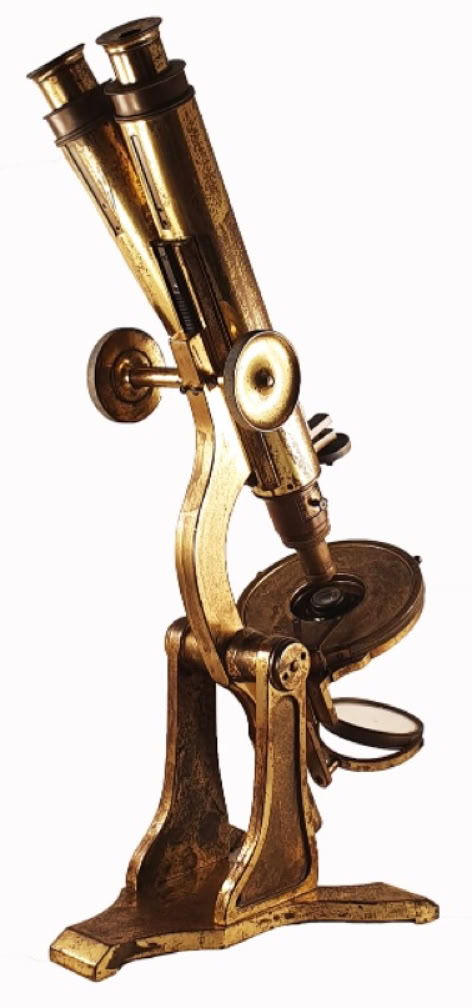
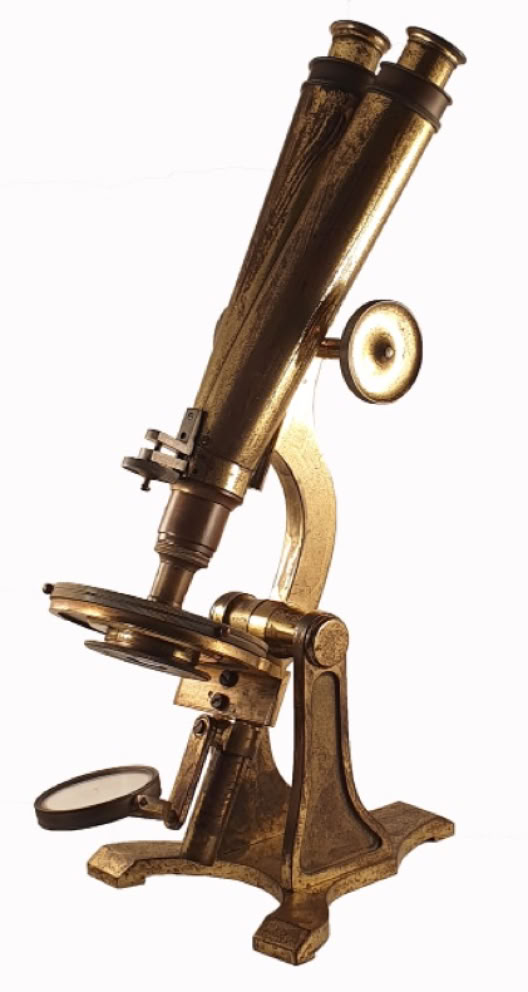
Microscope 532 bears the signature ‘H. & W. CROUCH, 64A BISHOPSGATE ST, LONDON’ and the serial number 308. Based on its address and serial number, it can be dated to around 1865. The instrument was illustrated and described as Crouch's Student's Binocular Microscope in William Carpenter's The Microscope and its Revelations (editions of 1868 and 1875; Figure 1). Carpenter explained that the instrument had been developed at a time when binocular microscopes were still largely the preserve of makers of high-end instruments. Its principal merit was that it made a convenient, well-constructed binocular microscope accessible to students at a price comparable to that normally charged merely for adding a Wenham prism and secondary body to a conventional microscope. He further noted that, following subsequent improvements, it remained one of the best instruments in its class, recommending it as an inexpensive, good-quality and portable binocular microscope. He also highlighted the availability of a version incorporating the rotary movement that he considered particularly important.
The same instrument was listed as Crouch's Binocular Microscope in James Queen's 1870 catalogue (Figure 1), which similarly praised its combination of affordability, quality and portability. The catalogue described its double body as being supported by a limb based on the Lister model. The inter-pupillary distance was adjusted through a transverse bar attached to one eyepiece and passing through a slotted fitting on the other. Moving the projecting pin raised or lowered the bar, simultaneously adjusting the position of both eyepieces. The circular stage consisted of a polished black-glass plate over which the object holder could be moved freely in any direction. The arrangement also allowed the specimen to rotate concentrically around the optical axis, a feature the catalogue regarded as indispensable in a good binocular microscope.
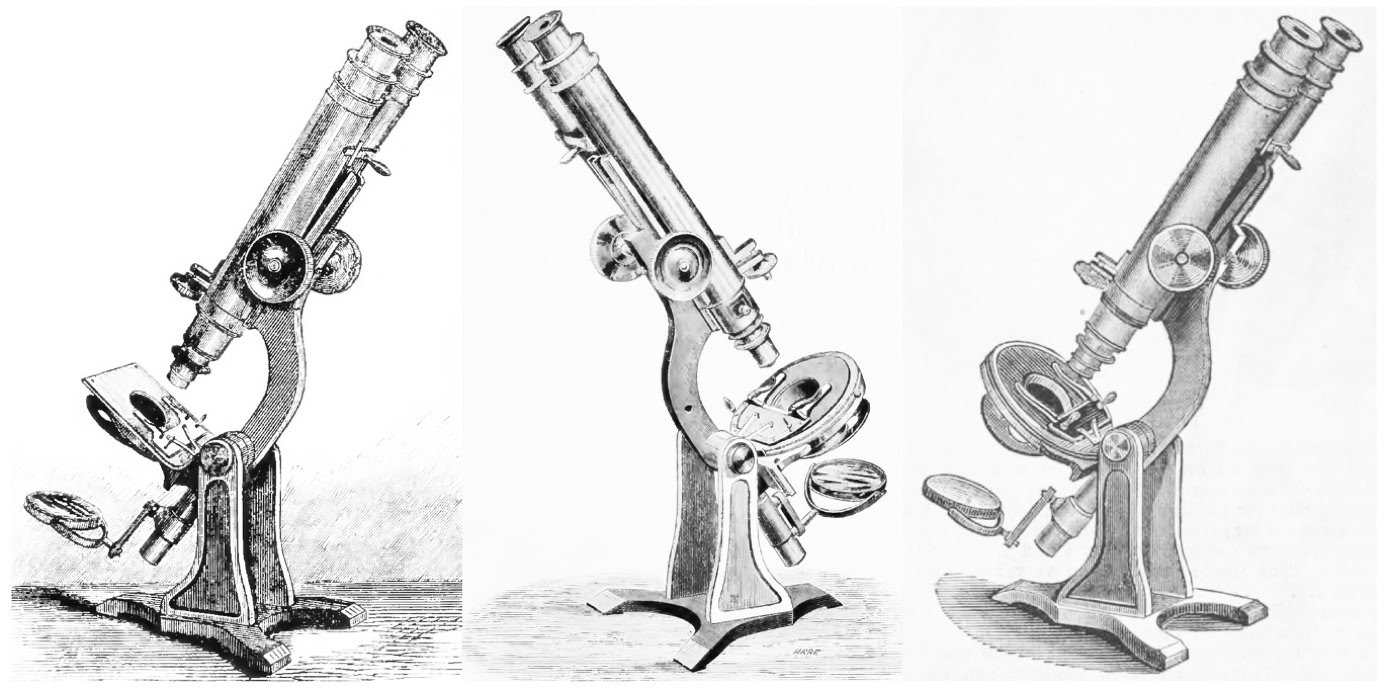
Figure 1. Crouch’s student’s binocular microscope as featured in the 1868 (left) and 1875 (centre) editions of W. Carpenter’s book “The microscope and its revelations”, and in James Queen’s 1870 catalogue (right).